


BRIAN WILSON, 1942–2025
By turns Mozart with a surfboard and a neurotic Icarus of the American dream, Brian Wilson—the fragile, fearless genius behind The Beach Boys—has died at 82. If Chuck Berry wrote the roadmap for teen America, Wilson turned the backseat into a cathedral. CLICK HERE TO READ MORE.
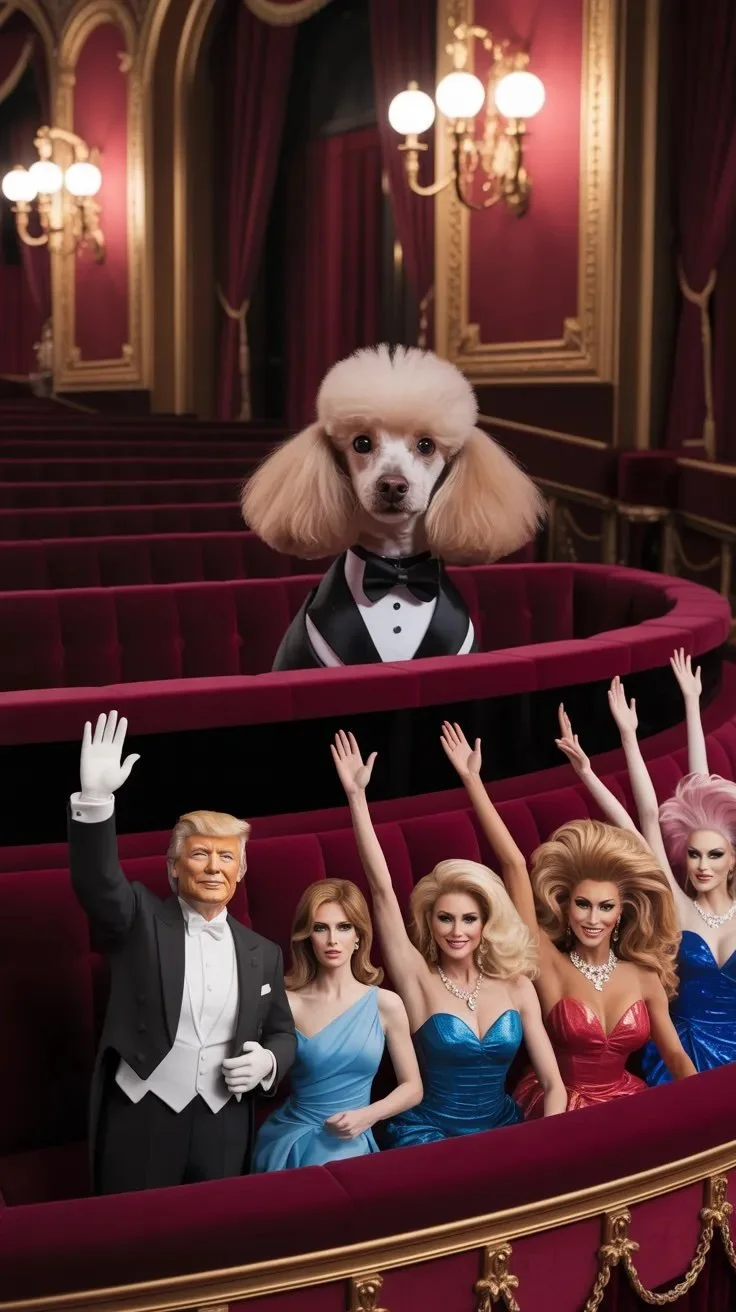
A Drag, Indeed:
It must be said that few men possess the talent to turn a night at the theatre into an act of national embarrassment, but Mr. Trump, to his credit, continues to innovate. There he stood, tuxedoed and glowering, at the Kennedy Center — a monument to culture now chaired by a man whose chief artistic achievement is the invention of the three-scoop ice cream sundae. Into this tableau swept a coterie of drag queens, their sequins gleaming, their applause thundering, and somewhere in the wings, one suspects, Victor Hugo himself was heard to laugh.
The evening, alas, did not proceed as His Eminence…CLICK HERE TO READ MORE.
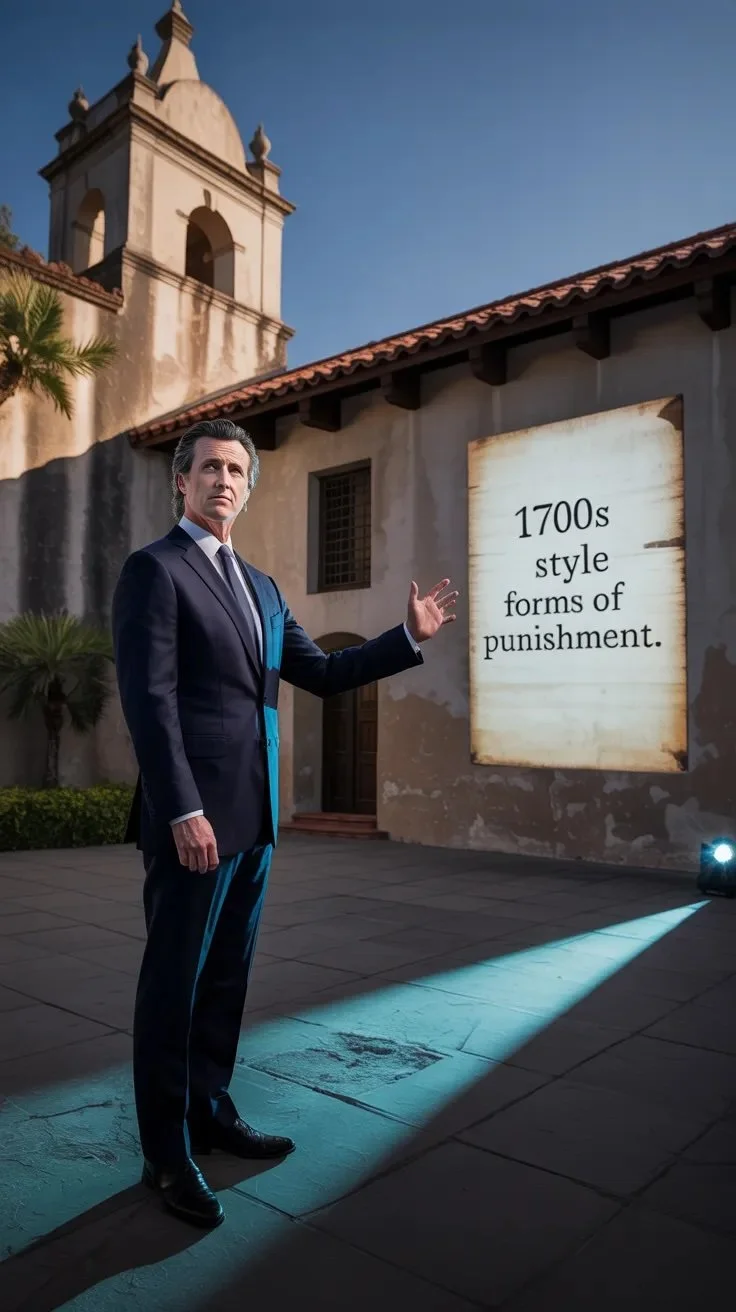
Tar, Feathers, and Bull— The Old Game in a New Suit
You ever watch a man get so puffed up with his own self-importance that he forgets the whole room’s watching? That’s what we got this week, folks.
House Speaker Mike Johnson — a man who couldn’t beat an egg in a small town bake-off — stands at the podium in Washington, cameras rolling, and says California Governor Gavin Newsom ought to be “tarred and feathered.” I kid you not. Tarred. Feathered. Like we’re all extras in some Revolutionary War theme park. And they call this leadership? CLICK HERE TO READ MORE
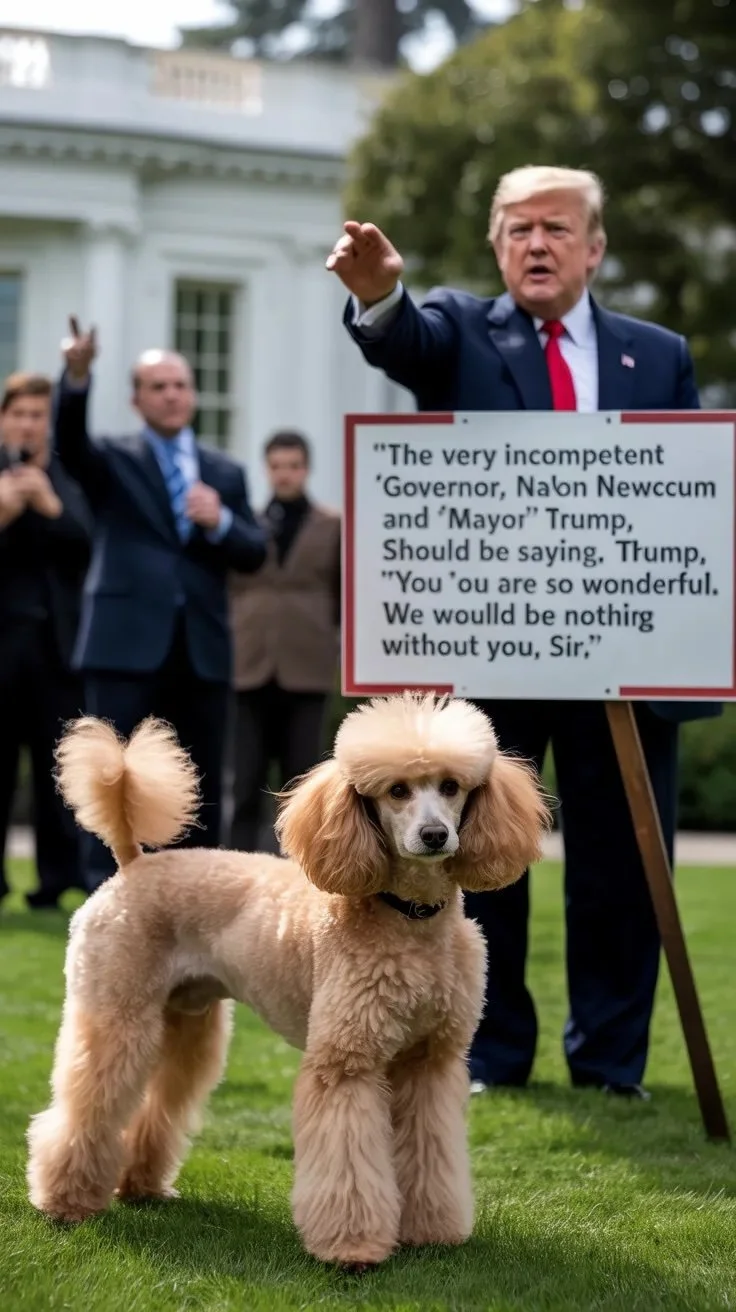
The Big Man Calls for the Cuffs
By now, folks who’ve been around a while know a hustle when they see one. And what we’ve got here is the biggest huckster of them all, standing on the White House lawn, grinning like a butcher’s cat, telling the country it’d be “great” if his hand-picked border man locked up the governor of California. CLICK HERE TO READ MORE.

The Proud Boys Went from Rioters to Plaintiffs Without Blushing
So get this — you’re not gonna believe it — five leaders of the Proud Boys. You know, the guys who thought they were starring in a Netflix special called How to Overthrow a Government in 48 Hours or Less. They’ve now filed a lawsuit. Against the U.S. Government. For $100 million dollars. That’s right — one hundred million dollars! I tell ya, even Meyer Lansky woulda blushed.
These fellas — who were already convicted, mind…CLICK HERE FOR MORE
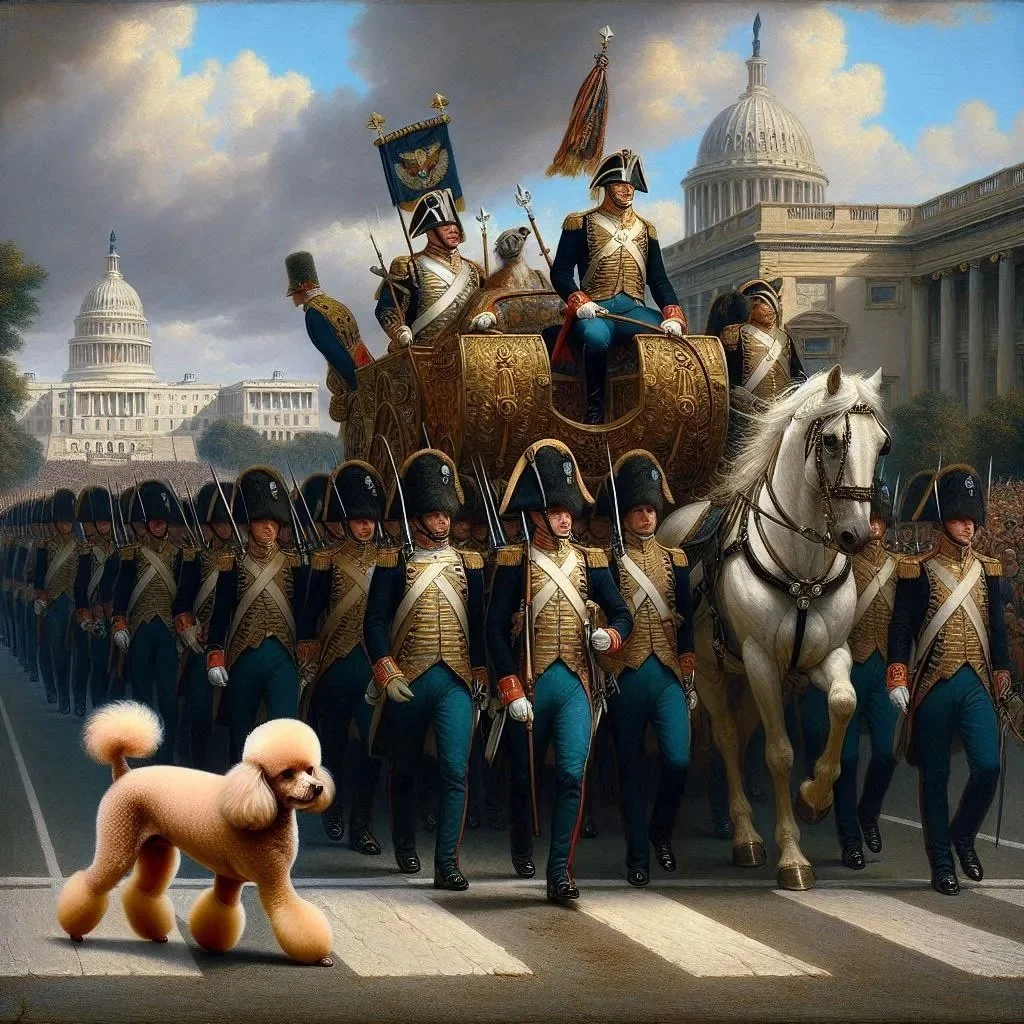
The Parable of the Parade: How a Free Republic Came to Mimic Its Enemies
It is a curious thing to celebrate a republic’s armed forces in a manner befitting a dictatorship. But this is the state of affairs in the American capital, where, on June 14th, to honor both the 250th anniversary of the U.S. Army and, not coincidentally, the birthday of President Donald Trump, the streets of Washington will tremble beneath the treads of 28 M1 Abrams battle tanks.
The celebration will feature 150 military vehicles, 50 aircraft, a…CLICK HERE FOR MORE

“The Meth, the Machine Gun, and the Meerkats: A Nature Special”
[David Attenborough voice]
Here, nestled along the misty coastal plains of southern Oregon, we find a truly remarkable gathering of creatures: camels, kangaroos, kinkajous, and—until recently—a deeply suspicious quantity of methamphetamine.
[Marlin Perkins voice]
That’s right, Dave. The West Coast Game Park Safari looked like your average American roadside animal attraction: goats, cougars, maybe a wallaby or two. But underneath the surface? A wildlife soap opera meets a low-budget episode of Breaking Bad.
[Cut to a grumpy capuchin monkey named Randy]
“Oh yeah, we knew something was off. You don’t see 44 firearms and a modified machine gun stashed under a pile of lemur chow without askin’ questions. I mean, one time I found a pistol in my hammock. Thought it was enrichment.”
[Attenborough, solemnly]
The dominant male of the enclosure, one Brian Tenney, age 52, has been removed from the habitat following an unexpected and highly unusual raid—led not by rival predators, but the Coos County Sheriff’s Department.
[Marlin Perkins]
They found 80 grams of meth, 8 grams of cocaine, and $1.6 million in cash. Folks, that’s not a safari. That’s a cartel with petting privileges.

Portrait of a Vandal:
It is a pitiful marker of the cultural IQ of a declining republic that the President of the United States—Donald J. Trump, a man for whom art has always been merely the wallpaper of ego—has decided to remove Kim Sajet from her position as Director of the National Portrait Gallery. Her crime, according to the president’s own blaring, characteristically illiterate dispatch on Truth Social, was that she was “highly partisan” and a “strong supporter of DEI,” which he pronounced, with the finality of a mall-court pharaoh, as “totally inappropriate” for her position.
Thus, Sajet—a scholar, a curator, an immigrant, and yes, a believer in the revolting notion that American culture might benefit from including more than just dead white men in powdered wigs—has been summarily fired by a man whose own official portrait, should it ever be permitted to hang in any institution not run by QVC, would properly be rendered in crayon, ketchup, and spray tan.
Let us be clear: Trump’s disdain for DEI (diversity, equity, and inclusion) is not rooted in philosophical disagreement. This is not Burke versus Rousseau. It is not even Nixon versus the NEA. It is the flailing tantrum of a man who sees any nod to pluralism as a threat to the soft, white dough of his self-image. “Restoring Truth and Sanity to American History,” his executive order declares—as if “truth” had ever flowed from Mar-a-Lago except as a casualty.
Kim Sajet’s résumé would be impressive to any thinking person—which is to say, not the present administration. Born in Nigeria, raised in Australia, educated in Europe and the U.S., with a doctorate from Georgetown and executive training at Harvard, she represents precisely the sort of worldly intellect that Trump regards with uncomprehending suspicion, like a terrier eyeing a ceiling fan. That she curated not just the Obama portraits but presided over their five-city tour—bringing Americans face to face with the visages of a presidency Trump still broods over like a Shakespearean ghost—is surely the unforgivable sin here. She let the nation celebrate its cultural evolution, and for that she must be punished.
To call Trump’s act stupid is to underestimate the word. It is anti-intellectual, certainly, but it is also anti-civic. It is the cultural equivalent of urinating on a library, then blaming the librarian for the smell. Under Sajet, the Portrait Gallery did not become a “leftist den,” as the president’s unwashed footmen might shout on cable news; it simply became relevant. She ushered in exhibitions that asked real questions: Who gets remembered? Who gets seen? What does portraiture mean when the faces on the wall start to resemble the nation beyond the old elite?
Trump, of course, wants a Portrait Gallery where every wall is a mirror. A nation of one face, his, endlessly repeated like some capitalist Warhol nightmare: Trump in a cowboy hat. Trump in a flight suit. Trump next to Lincoln, Trump over Lincoln. That’s the limit of his aesthetic: narcissism cosplaying as patriotism.
His war on “wokeness” in museums—oh, what a depressing phrase, as if cultural institutions are now battlefields in the fetid imaginations of the aggrieved—is just another twitch in his long campaign against history that fails to flatter him. “Race-centered ideology,” he calls it, as if history itself were an act of aggression. In truth, what Trump cannot tolerate is ambiguity. The museum to him is either a loyalty test or a heresy.
Firing Sajet is part of a wider purge—he’s already sacked the Librarian of Congress, the Chair of the Joint Chiefs, and the Commandant of the Coast Guard. At this rate, the next head to roll will be the bronze statue of Frederick Douglass for being too verbose. The president is trimming the nation’s cultural branches with a blowtorch, leaving nothing behind but the smoke of grievance and cheap nostalgia.
The tragedy, of course, is not only that such a vandal holds power, but that so many cheer him on. In a healthy society, the dismissal of a museum director over “support” for inclusion would provoke outrage, not applause. But we are no longer a society invested in complexity or memory. We are a culture nursing its resentments like whiskey, grumbling at clouds and calling it populism.
Robert Hughes once said that the loss of critical thinking in American public life was “the slow death of the republic by boredom and bile.” This, then, is another knifewound in that body. Sajet’s removal is not a minor administrative change. It is a cultural obscenity, the replacement of merit with malice.
But let us not mourn too long. The galleries may be stripped. The plaques may be rewritten. But art, real art, will survive its saboteurs. And so will history.
Because the problem with purging the past, Mr. President, is that eventually it comes back—in portrait form.
And it remembers.

The TACO Doctrine:
The TACO Doctrine: A Study in Presidential Evasion
In the grand theater of economic policy, it is often tempting to mistake the clamor of cymbals for the resonance of conviction. Nowhere has this confusion been more persistently dramatized than in the peculiar choreography of President Donald Trump’s trade strategy—a spectacle of bold beginnings followed, almost invariably, by a retreat into bathos. The term now catching currency among economists and even the more impish bond traders is “TACO,” an acronym both zesty and damning: Trump Always Chickens Out.
Let us be clear. Tariffs are not a novelty. They are, in fact, among the oldest tools in the nation-state’s kit of self-inflicted wounds. Yet they have, on occasion, served a purpose—usually ill-defined, sometimes unintentionally. What is remarkable in the Trumpian era is not the resort to tariffs but the theatricality of their announcement, the drama of their declaration, and the predictability of their subsequent dilution.
At the outset, we were promised a new age of economic nationalism. American steel and aluminum would rise again; the trade deficit would melt like morning frost; China would be brought to heel; Mexico would pay—presumably in both currency and humility. In short, we were to believe that the businessman-president, with his infinite swagger, would do for the American worker what decades of globalist ne’er-do-wells could not.
And yet, time and again, when the moment of maximal leverage arrived—when the game required resolve rather than rhetoric—the president, to use the economic term of art, folded. What was touted as a 25% tariff would become a 10% deferral, then a partial exemption, then, most ignobly, a handshake deal signed in gold Sharpie and undone by Tuesday.
The Chinese, whose sense of irony is only matched by their patience, mastered the dance. They endured insult, tariffs, and tweets, only to find themselves, six months later, at a negotiating table set with the same empty platitudes and a president who craved applause more than leverage. The so-called “Phase One Deal,” that pinnacle of Trumpian tradecraft, produced not transformation, but soybeans—modestly purchased, ambiguously promised, and mostly forgotten.
To invoke Galbraith himself, one is reminded of his observation that “the modern conservative is engaged in one of man’s oldest exercises in moral philosophy; that is, the search for a superior moral justification for selfishness.” The modern Trumpist is engaged in something similar, though more comical: the search for a superior branding strategy for economic cowardice.
It is here that the TACO doctrine finds its true utility—not merely as insult, but as diagnosis. It speaks to a governing style where belligerence is substituted for strategy, and capitulation is camouflaged by fanfare. Trump’s tariff regime was less a doctrine than a dopamine hit. Each announcement brought a surge of attention, a brief rise in approval among the aggrieved, and then, once the cameras turned away, the predictable slide into ambiguity, exemption, and surrender.
In the end, what we are left with is not a trade realignment but a parable. A lesson in how bluster, unmoored from discipline, leaves neither friend nor foe certain of intent. TACO, then, is not just an acronym. It is an epitaph for a strategy that mistook shouting for strength and compromise for conquest.
As Galbraith might have said, though perhaps with more grace than this humble interpreter: “In economics, as in politics, it is not enough to be loudly wrong. One must, at the very least, avoid being repeatedly ridiculous.”

A Good Country for Thieves
The Quiet Below the Flag
On Power, Profit, and the Death of Shame in Washington
The man promised to drain the swamp. Instead, he paved it and built a hotel. He called it sacrifice. The numbers said otherwise.
Back in office and now a convicted felon, he stood atop a government stripped of watchdogs and filled with loyalists. He made sure the rules didn’t apply to him—and they didn’t. He said so, and no one stopped him.
The money came in. From Qatar. From crypto. From countries that once needed permission, now needing only proximity. His sons took meetings. They signed deals. They laughed at the idea of restraint. Why hold back when the crowd doesn’t boo anymore?
There were once hearings for this sort of thing. Now there are podcasts. A man called it corruption, but only “seemed like.” That was as far as outrage went—an implied shrug wrapped in audio. Nothing stuck long enough to matter. The country was too tired. Too wired. Too numb.
The president said he was too rich to need more money. But he took it anyway. Planes. Partnerships. A $1.2 billion jump in net worth. The figures were public. The silence was louder.
A judge called it the most brazen abuse of office in history. But history doesn’t press charges. The Justice Department had new management. Oversight was out to lunch. Ethics had a Do Not Disturb sign on the door.
Some protested. Some posted. The rest adjusted.
He had changed the rules, and then made it clear there were no rules. Not for him. Not anymore.
The swamp didn’t disappear. It became private property. Membership required influence. Entry was granted in Bitcoin or blood loyalty.
Above it all, the flag still waved. But beneath it, the silence had settled. Cold. Heavy. Permanent.
And no one moved to fix it.
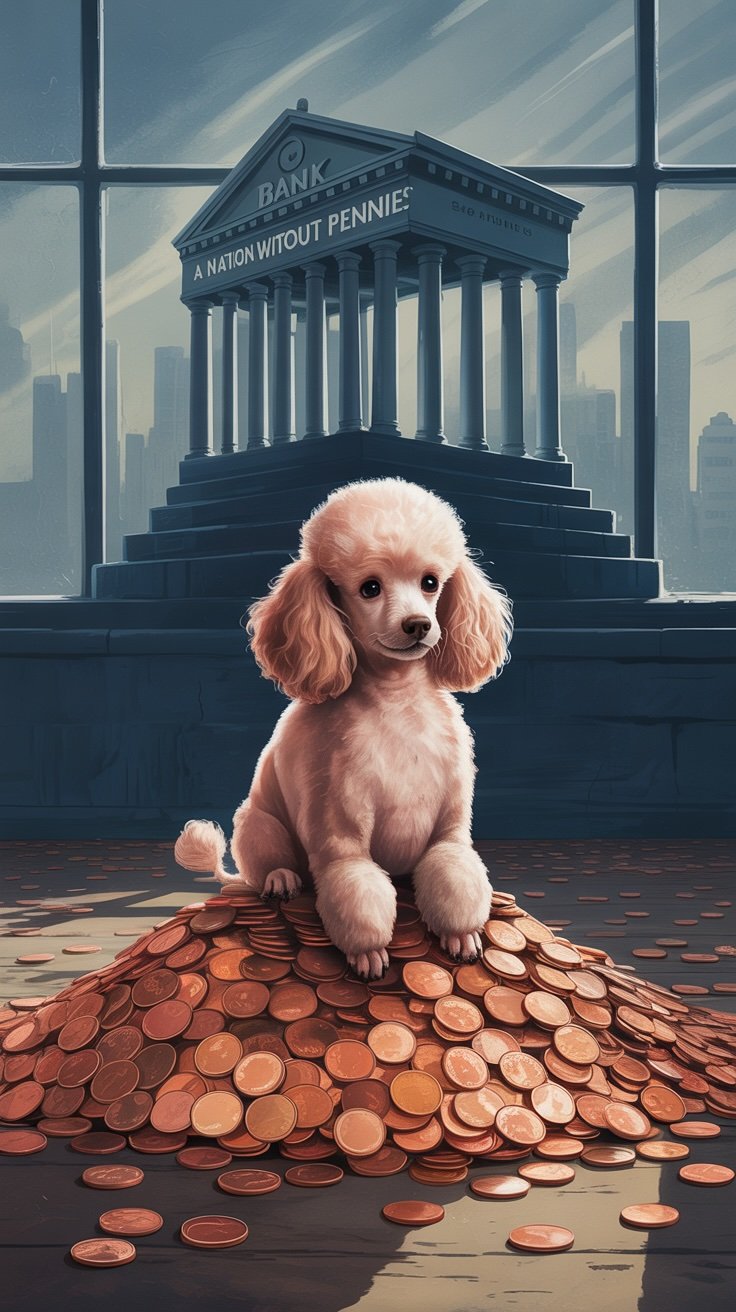
A Nation Without Pennies:
A Nation Without Pennies: Progress or Pernicious Folly?
Progress or Pernicious Folly?
The United States government, in its infinite economic wisdom and spiritual smallness, has announced that it shall cease the production of pennies — that humble, copper-colored disc upon which generations of American children first learned the weight and worth of money.
At first glance, this might seem the act of a practical and forward-thinking Republic. After all, why should a nation that prides itself on efficiency waste nearly four cents to produce a coin worth but one? But let us not be so easily seduced by the arithmetic of accountants and the penny-pinching triumphalism of Treasury officials. This is no mere cost-saving measure. This is the quiet burial of thrift.
Let it be plainly stated: by eliminating the penny, the government is embedding inflation into the very arithmetic of daily life. Prices that once might have ended in .01 or .02 will now round up. Do not be fooled by the false comfort of symmetry — rounding is not neutral when it bends always toward the richer till. The burden of those extra cents will fall not upon stockbrokers or senators, but upon those who pay in cash — the young, the old, the poor, and those who cannot count on banking apps to do their bidding.
The government assures us that this change is merely a continuation of modernity — that Canada and New Zealand have already led the way. That is well. But is the metric for progress now measured solely by imitation? And shall we next abolish dimes, and quarters, until a dollar buys only what a quarter once did, and the value of money is as inflated as our egos?
Worse still, the demise of the penny is a quiet assault upon the moral education of children. We are told the coins end up in couch cushions and art projects — well! What better proof that they belong in the hands of children? For it is through the clinking of small coins in a piggy bank that a child learns patience, responsibility, and the rudiments of economics. To deprive them of that is to render saving itself quaint, a relic of a world where one waited, scrimped, and earned.
Let us also not forget the symbolism of the penny — humble, ubiquitous, and bearing the likeness of Abraham Lincoln, a man who rose from poverty by the sweat of thought and moral courage. To erase his coin is not only an economic gesture, but a cultural one — the slow erasure of modest beginnings in favor of lofty efficiencies.
The Treasury boasts a savings of $56 million by halting penny production — a mere pittance in a government that spends trillions with the looseness of a gambler. What is $56 million, next to the moral bankruptcy of teaching a child that one cent no longer matters?A Nation Without Pennies: Progress or Pernicious Folly?
Progress or Pernicious Folly?
The United States government, in its infinite economic wisdom and spiritual smallness, has announced that it shall cease the production of pennies — that humble, copper-colored disc upon which generations of American children first learned the weight and worth of money.
At first glance, this might seem the act of a practical and forward-thinking Republic. After all, why should a nation that prides itself on efficiency waste nearly four cents to produce a coin worth but one? But let us not be so easily seduced by the arithmetic of accountants and the penny-pinching triumphalism of Treasury officials. This is no mere cost-saving measure. This is the quiet burial of thrift.
Let it be plainly stated: by eliminating the penny, the government is embedding inflation into the very arithmetic of daily life. Prices that once might have ended in .01 or .02 will now round up. Do not be fooled by the false comfort of symmetry — rounding is not neutral when it bends always toward the richer till. The burden of those extra cents will fall not upon stockbrokers or senators, but upon those who pay in cash — the young, the old, the poor, and those who cannot count on banking apps to do their bidding.
The government assures us that this change is merely a continuation of modernity — that Canada and New Zealand have already led the way. That is well. But is the metric for progress now measured solely by imitation? And shall we next abolish dimes, and quarters, until a dollar buys only what a quarter once did, and the value of money is as inflated as our egos?
Worse still, the demise of the penny is a quiet assault upon the moral education of children. We are told the coins end up in couch cushions and art projects — well! What better proof that they belong in the hands of children? For it is through the clinking of small coins in a piggy bank that a child learns patience, responsibility, and the rudiments of economics. To deprive them of that is to render saving itself quaint, a relic of a world where one waited, scrimped, and earned.
Let us also not forget the symbolism of the penny — humble, ubiquitous, and bearing the likeness of Abraham Lincoln, a man who rose from poverty by the sweat of thought and moral courage. To erase his coin is not only an economic gesture, but a cultural one — the slow erasure of modest beginnings in favor of lofty efficiencies.
The Treasury boasts a savings of $56 million by halting penny production — a mere pittance in a government that spends trillions with the looseness of a gambler. What is $56 million, next to the moral bankruptcy of teaching a child that one cent no longer matters?A Nation Without Pennies: Progress or Pernicious Folly?
Progress or Pernicious Folly?
The United States government, in its infinite economic wisdom and spiritual smallness, has announced that it shall cease the production of pennies — that humble, copper-colored disc upon which generations of American children first learned the weight and worth of money.
At first glance, this might seem the act of a practical and forward-thinking Republic. After all, why should a nation that prides itself on efficiency waste nearly four cents to produce a coin worth but one? But let us not be so easily seduced by the arithmetic of accountants and the penny-pinching triumphalism of Treasury officials. This is no mere cost-saving measure. This is the quiet burial of thrift.
Let it be plainly stated: by eliminating the penny, the government is embedding inflation into the very arithmetic of daily life. Prices that once might have ended in .01 or .02 will now round up. Do not be fooled by the false comfort of symmetry — rounding is not neutral when it bends always toward the richer till. The burden of those extra cents will fall not upon stockbrokers or senators, but upon those who pay in cash — the young, the old, the poor, and those who cannot count on banking apps to do their bidding.
The government assures us that this change is merely a continuation of modernity — that Canada and New Zealand have already led the way. That is well. But is the metric for progress now measured solely by imitation? And shall we next abolish dimes, and quarters, until a dollar buys only what a quarter once did, and the value of money is as inflated as our egos?
Worse still, the demise of the penny is a quiet assault upon the moral education of children. We are told the coins end up in couch cushions and art projects — well! What better proof that they belong in the hands of children? For it is through the clinking of small coins in a piggy bank that a child learns patience, responsibility, and the rudiments of economics. To deprive them of that is to render saving itself quaint, a relic of a world where one waited, scrimped, and earned.
Let us also not forget the symbolism of the penny — humble, ubiquitous, and bearing the likeness of Abraham Lincoln, a man who rose from poverty by the sweat of thought and moral courage. To erase his coin is not only an economic gesture, but a cultural one — the slow erasure of modest beginnings in favor of lofty efficiencies.
The Treasury boasts a savings of $56 million by halting penny production — a mere pittance in a government that spends trillions with the looseness of a gambler. What is $56 million, next to the moral bankruptcy of teaching a child that one cent no longer matters?A Nation Without Pennies: Progress or Pernicious Folly?
Progress or Pernicious Folly?
The United States government, in its infinite economic wisdom and spiritual smallness, has announced that it shall cease the production of pennies — that humble, copper-colored disc upon which generations of American children first learned the weight and worth of money.
At first glance, this might seem the act of a practical and forward-thinking Republic. After all, why should a nation that prides itself on efficiency waste nearly four cents to produce a coin worth but one? But let us not be so easily seduced by the arithmetic of accountants and the penny-pinching triumphalism of Treasury officials. This is no mere cost-saving measure. This is the quiet burial of thrift.
Let it be plainly stated: by eliminating the penny, the government is embedding inflation into the very arithmetic of daily life. Prices that once might have ended in .01 or .02 will now round up. Do not be fooled by the false comfort of symmetry — rounding is not neutral when it bends always toward the richer till. The burden of those extra cents will fall not upon stockbrokers or senators, but upon those who pay in cash — the young, the old, the poor, and those who cannot count on banking apps to do their bidding.
The government assures us that this change is merely a continuation of modernity — that Canada and New Zealand have already led the way. That is well. But is the metric for progress now measured solely by imitation? And shall we next abolish dimes, and quarters, until a dollar buys only what a quarter once did, and the value of money is as inflated as our egos?
Worse still, the demise of the penny is a quiet assault upon the moral education of children. We are told the coins end up in couch cushions and art projects — well! What better proof that they belong in the hands of children? For it is through the clinking of small coins in a piggy bank that a child learns patience, responsibility, and the rudiments of economics. To deprive them of that is to render saving itself quaint, a relic of a world where one waited, scrimped, and earned.
Let us also not forget the symbolism of the penny — humble, ubiquitous, and bearing the likeness of Abraham Lincoln, a man who rose from poverty by the sweat of thought and moral courage. To erase his coin is not only an economic gesture, but a cultural one — the slow erasure of modest beginnings in favor of lofty efficiencies.
The Treasury boasts a savings of $56 million by halting penny production — a mere pittance in a government that spends trillions with the looseness of a gambler. What is $56 million, next to the moral bankruptcy of teaching a child that one cent no longer matters?A Nation Without Pennies: Progress or Pernicious Folly?
Progress or Pernicious Folly?
The United States government, in its infinite economic wisdom and spiritual smallness, has announced that it shall cease the production of pennies — that humble, copper-colored disc upon which generations of American children first learned the weight and worth of money.
At first glance, this might seem the act of a practical and forward-thinking Republic. After all, why should a nation that prides itself on efficiency waste nearly four cents to produce a coin worth but one? But let us not be so easily seduced by the arithmetic of accountants and the penny-pinching triumphalism of Treasury officials. This is no mere cost-saving measure. This is the quiet burial of thrift.
Let it be plainly stated: by eliminating the penny, the government is embedding inflation into the very arithmetic of daily life. Prices that once might have ended in .01 or .02 will now round up. Do not be fooled by the false comfort of symmetry — rounding is not neutral when it bends always toward the richer till. The burden of those extra cents will fall not upon stockbrokers or senators, but upon those who pay in cash — the young, the old, the poor, and those who cannot count on banking apps to do their bidding.
The government assures us that this change is merely a continuation of modernity — that Canada and New Zealand have already led the way. That is well. But is the metric for progress now measured solely by imitation? And shall we next abolish dimes, and quarters, until a dollar buys only what a quarter once did, and the value of money is as inflated as our egos?
Worse still, the demise of the penny is a quiet assault upon the moral education of children. We are told the coins end up in couch cushions and art projects — well! What better proof that they belong in the hands of children? For it is through the clinking of small coins in a piggy bank that a child learns patience, responsibility, and the rudiments of economics. To deprive them of that is to render saving itself quaint, a relic of a world where one waited, scrimped, and earned.
Let us also not forget the symbolism of the penny — humble, ubiquitous, and bearing the likeness of Abraham Lincoln, a man who rose from poverty by the sweat of thought and moral courage. To erase his coin is not only an economic gesture, but a cultural one — the slow erasure of modest beginnings in favor of lofty efficiencies.
The Treasury boasts a savings of $56 million by halting penny production — a mere pittance in a government that spends trillions with the looseness of a gambler. What is $56 million, next to the moral bankruptcy of teaching a child that one cent no longer matters?A Nation Without Pennies: Progress or Pernicious Folly?
Progress or Pernicious Folly?
The United States government, in its infinite economic wisdom and spiritual smallness, has announced that it shall cease the production of pennies — that humble, copper-colored disc upon which generations of American children first learned the weight and worth of money.
At first glance, this might seem the act of a practical and forward-thinking Republic. After all, why should a nation that prides itself on efficiency waste nearly four cents to produce a coin worth but one? But let us not be so easily seduced by the arithmetic of accountants and the penny-pinching triumphalism of Treasury officials. This is no mere cost-saving measure. This is the quiet burial of thrift.
Let it be plainly stated: by eliminating the penny, the government is embedding inflation into the very arithmetic of daily life. Prices that once might have ended in .01 or .02 will now round up. Do not be fooled by the false comfort of symmetry — rounding is not neutral when it bends always toward the richer till. The burden of those extra cents will fall not upon stockbrokers or senators, but upon those who pay in cash — the young, the old, the poor, and those who cannot count on banking apps to do their bidding.
The government assures us that this change is merely a continuation of modernity — that Canada and New Zealand have already led the way. That is well. But is the metric for progress now measured solely by imitation? And shall we next abolish dimes, and quarters, until a dollar buys only what a quarter once did, and the value of money is as inflated as our egos?
Worse still, the demise of the penny is a quiet assault upon the moral education of children. We are told the coins end up in couch cushions and art projects — well! What better proof that they belong in the hands of children? For it is through the clinking of small coins in a piggy bank that a child learns patience, responsibility, and the rudiments of economics. To deprive them of that is to render saving itself quaint, a relic of a world where one waited, scrimped, and earned
Let us also not forget the symbolism of the penny — humble, ubiquitous, and bearing the likeness of Abraham Lincoln, a man who rose from poverty by the sweat of thought and moral courage. To erase his coin is not only an economic gesture, but a cultural one — the slow erasure of modest beginnings in favor of lofty efficien
The Treasury boasts a savings of $56 million by halting penny production — a mere pittance in a government that spends trillions with the looseness of a gambler. What is $56 million, next to the moral bankruptcy of teaching a child that one cent no longer matters?A Nation Without Pennies: Progress or Pernicious Folly?
Progress or Pernicious Folly?
The United States government, in its infinite economic wisdom and spiritual smallness, has announced that it shall cease the production of pennies — that humble, copper-colored disc upon which generations of American children first learned the weight and worth of
At first glance, this might seem the act of a practical and forward-thinking Republic. After all, why should a nation that prides itself on efficiency waste nearly four cents to produce a coin worth but one? But let us not be so easily seduced by the arithmetic of accountants and the penny-pinching triumphalism of Treasury officials. This is no mere cost-saving measure. This is the quiet burial of thrift.
Let it be plainly stated: by eliminating the penny, the government is embedding inflation into the very arithmetic of daily life. Prices that once might have ended in .01 or .02 will now round up. Do not be fooled by the false comfort of symmetry — rounding is not neutral when it bends always toward the richer till. The burden of those extra cents will fall not upon stockbrokers or senators, but upon those who pay in cash — the young, the old, the poor, and those who cannot count on banking apps to do their bi
The government assures us that this change is merely a continuation of modernity — that Canada and New Zealand have already led the way. That is well. But is the metric for progress now measured solely by imitation? And shall we next abolish dimes, and quarters, until a dollar buys only what a quarter once did, and the value of money is as inflated as our
Worse still, the demise of the penny is a quiet assault upon the moral education of children. We are told the coins end up in couch cushions and art projects — well! What better proof that they belong in the hands of children? For it is through the clinking of small coins in a piggy bank that a child learns patience, responsibility, and the rudiments of economics. To deprive them of that is to render saving itself quaint, a relic of a world where one waited, scrimped, and earned.
Let us also not forget the symbolism of the penny — humble, ubiquitous, and bearing the likeness of Abraham Lincoln, a man who rose from poverty by the sweat of thought and moral courage. To erase his coin is not only an economic gesture, but a cultural one — the slow erasure of modest beginnings in favor of lofty efficiencies.
A Nation Without Pennies: Progress or Pernicious Folly?
Progress or Pernicious Folly?
The United States government, in its infinite economic wisdom and spiritual smallness, has announced that it shall cease the production of pennies — that humble, copper-colored disc upon which generations of American children first learned the weight and worth of money.
At first glance, this might seem the act of a practical and forward-thinking Republic. After all, why should a nation that prides itself on efficiency waste nearly four cents to produce a coin worth but one? But let us not be so easily seduced by the arithmetic of accountants and the penny-pinching triumphalism of Treasury officials. This is no mere cost-saving measure. This is the quiet burial of thrift.
Let it be plainly stated: by eliminating the penny, the government is embedding inflation into the very arithmetic of daily life. Prices that once might have ended in .01 or .02 will now round up. Do not be fooled by the false comfort of symmetry — rounding is not neutral when it bends always toward the richer till. The burden of those extra cents will fall not upon stockbrokers or senators, but upon those who pay in cash — the young, the old, the poor, and those who cannot count on banking apps to do their bidding.
The government assures us that this change is merely a continuation of modernity — that Canada and New Zealand have already led the way. That is well. But is the metric for progress now measured solely by imitation? And shall we next abolish dimes, and quarters, until a dollar buys only what a quarter once did, and the value of money is as inflated as our egos?
Worse still, the demise of the penny is a quiet assault upon the moral education of children. We are told the coins end up in couch cushions and art projects — well! What better proof that they belong in the hands of children? For it is through the clinking of small coins in a piggy bank that a child learns patience, responsibility, and the rudiments of economics. To deprive them of that is to render saving itself quaint, a relic of a world where one waited, scrimped, and earned.
Let us also not forget the symbolism of the penny — humble, ubiquitous, and bearing the likeness of Abraham Lincoln, a man who rose from poverty by the sweat of thought and moral courage. To erase his coin is not only an economic gesture, but a cultural one — the slow erasure of modest beginnings in favor of lofty efficiencies. The Treasury boasts a savings of $56 million by halting penny production — a mere pittance in a government that spends trillions with the looseness of a gambler. What is $56 million, next to the moral bankruptcy of teaching a child that one cent no longer matters?
The Treasury boasts a savings of $56 million by halting penny production — a mere pittance in a government that spends trillions with the looseness of a gambler. What is $56 million, next to the moral bankruptcy of teaching a child that one cent no longer matters?

“Peep Show Gone Wrong:
“Peep Show Gone Wrong: Chicks, Mail Trucks, and Postal Madness”
Ladies and gentlemen, gather round — I’ve got a story for you. It’s got birds, bureaucracy, and a big ol’ box of what the hell happened?!
Picture this: 12,000 baby chicks — fluffy, peeping, tiny balls of potential omelets — shipped out from a hatchery in Pennsylvania. “Bon voyage, little fluffers! You’re off to farms across America!” Then… silence. Cue ominous music.
Three days later — not one, not two, three — somebody at the U.S. Postal Service goes, “Hey, what’s that chirping in the back of the truck?” SURPRISE! It’s 12,000 chicks — now down by a horrifying 4,000 due to starvation, heat, and good ol’ postal neglect.
No food, no water, no tiny fans going bzzz — just a box of feathery survivors goin’, “Is this Amazon Prime or a horror movie?”
And the Postal Service? They say, “Oh, this kind of thing… rarely happens.” Oh, rarely?! That’s like saying, “Your parachute usually works.”
The hatchery, Freedom Ranger (sounds like a chicken with a badge and a gun), says, “Not our fault! Can’t take them back — biosecurity, darling!” Which is code for, “No refunds on dead birds.”
Meanwhile, the surviving 8,000 chicks were taken to a Delaware shelter, where workers are now trying to adopt them out like, “Would you like one chick, or 400? They come in bulk. Great with toast.”
Only a few hundred have been adopted. That means thousands are still looking for a home. Cue Sarah McLachlan singing “In the Arms of the Angel”… but with chickens.
And let’s talk about PETA — they’ve been saying for years, “Don’t ship live animals like they’re junk mail!” But the USPS has been doing it for over a century, folks! That’s right — 100 years of “Neither snow nor rain nor dead poultry…”
Look — this ain’t just about chickens. It’s about empathy. It’s about how we treat life — even the little peeping kind. Because if we’re okay losing 4,000 baby birds in a truck and calling it “a rare issue,” we might wanna check our collective soul. Or at least open the damn truck once in a while.
So here’s to the surviving chicks. May they find homes, love, and hopefully never see the inside of a mail truck again.
Good night, God bless, and for heaven’s sake — someone buy those birds a fan and a juice box.

“This Is Your Brain on Patriotism”
There are moments in American life when you look around and realize the circus tent has collapsed. The elephants are dead, the clowns are armed, and the ringmaster is selling autographed gallows on eBay. We are living through that moment now — and nothing underscores it more grotesquely than the five-million-dollar payout to the family of Ashli Babbitt.
Yes, five million U.S. tax dollars, handed to the estate of a woman who died while breaking into the House of Representatives during a live insurrection. She wasn’t pushed. She wasn’t caught in the crossfire. She was at the front, climbing through broken glass toward a locked room filled with lawmakers who were quite literally hiding from people who wanted to hang the Vice President of the United States.
And for this, she is a martyr. A symbol. A golden calf carved out of the foam and rage of the MAGA movement. She is hailed by a former president, venerated by online mouth-breathers, and now — thanks to our spooked, spineless institutions — rewarded with a multimillion-dollar government check.
This is where we are.
This is who we are.
Because this story isn’t just about Babbitt. It’s about us — the American people — and the ugly, snarling, selfie-twitching animals so many of us have become.
THE GREAT UNGLUING
We used to have disagreements in this country. We had debates, elections, protest songs, op-eds, and dueling cable news channels with smug anchors in expensive ties. It was ridiculous — sure — but it was a system. Now? Now we live in two entirely separate realities with nothing but a shared Amazon Prime account between us.
In one reality, Ashli Babbitt is what she was: a radicalized woman charging into the seat of government as part of a mob — a mob that beat cops, smashed windows, smeared feces on the wall, and hunted human beings through marble halls like it was some warped colonial foxhunt. A mob that screamed “Hang Mike Pence” while waving flags that said “Jesus is My Savior, Trump is My President.”
In the other reality — the one piped into millions of living rooms through Facebook memes and dollar-store documentaries — she is Joan of Arc in a Trump hat. A patriot. A victim of tyranny. A sacred symbol of the movement. They put her face on flags, murals, T-shirts. Trump himself said, “She was innocently standing there.” Standing. As if she were window shopping at Target and not climbing into the last line of defense between democracy and a gallows crew.
They don’t believe the video. They don’t believe the police. They don’t believe anything that doesn’t come with a watermark from “Patriot Eagle Alert” or “@GodGunsFreedom1488.” They believe Trump — a man whose relationship with the truth is like a fish’s relationship with a bicycle.
And now, these delusions come with a price tag. Five million dollars’ worth.
INSTITUTIONAL COWARDICE
The Justice Department didn’t lose this case. They settled. Preemptively. Quietly. Without the mess of a trial, without cross-examination, without facts laid bare. Why? Because a trial would have been a public bonfire. MAGA world would’ve turned it into a crusade, a holy war, a media circus with gold-plated gallows and slogans printed by the metric ton. The feds blinked. They threw money at the problem. They paid off the ghost.
Meanwhile, Capitol Police Chief Tom Manger issued a lukewarm condemnation of the settlement. He said it sends a “chilling message.” He’s wrong. It sends a clear message: If your ideology is loud enough, and your delusion firm enough, and your lawyer armed with enough right-wing cash, you too can rewrite your place in history and get a check in the mail.
This country used to revere sacrifice. Now we revere grievance. We reward rage. We hand out trophies for defiance and checks for destruction. This isn’t justice — it’s hush money in a powdered wig.
WHO’S REALLY GETTING PAID?
Let’s talk numbers. There are over 1,500 people charged in connection with January 6. That’s not a protest — it’s a military-age mob with matching T-shirts. Many of them are in prison. Some got pardons. Some are running for Congress. Some are now selling merch with slogans like “Political Prisoner” and “Free the J6 Patriots” — as if they were caught planting tulips and not bear spray.
And the movement rolls on. Trump, the once-and-future chaos merchant, has made it clear: if he returns, the mob comes with him. He has already promised to pardon every last one. He called the insurrectionists “hostages.” He called Ashli Babbitt “a really good person.” This is not fringe anymore. This is policy.
And while the rest of us are choking on overpriced eggs and drowning in student debt, our tax dollars are being siphoned off to pay for the sins of people who think democracy is something you can smash through with a flagpole.
THE UGLY ONES
Look around. Listen carefully. The ugly ones are winning. The ones who cheer when people suffer. The ones who see violence as righteousness. The ones who call the truth a conspiracy and the mob “tourists.” They’re loud. They’re organized. And they’ve figured out how to weaponize grievance into currency.
They don’t want justice. They want spectacle. They want martyrdom. They want to see their faces on bumper stickers and their lies repeated on cable news. And now they want cash settlements, too.
Ashli Babbitt’s story should have been a cautionary tale — a tragic consequence of brainwashing and blind faith. Instead, it’s a payday.
What does it say about a country that rewards people for attacking it?
What does it say about a culture that canonizes delusion and bankrupts decency?
What does it say about us?
I’ll tell you what it says:
We are not the shining city on the hill anymore.
We’re the flaming double-wide at the edge of the swamp, and the porch light’s broken.

“You Bet Your IRS”
“You Bet Your IRS”
Billy Long goes from selling imaginary tax credits to running the IRS. Next up: Harpo for Secretary of Silence.
President Trump, a man who’s had more bankruptcies than birthdays, wants to put Billy Long, a former congressman from Missouri, in charge of the IRS. That’s like putting a pyromaniac in charge of Smokey Bear. It’s not a tax plan — it’s a fire sale!
Billy’s qualifications for this job? Oh, top-notch! He’s got no background in tax law, but he did take a three-day course from something called “Excel Empire.” I don’t know if that’s a tax school or a mattress store — but either way, I wouldn’t trust it to calculate a tip, let alone run the nation’s tax agency.
And get this — after Congress, Billy spent his time working with companies that promised folks giant IRS refunds using something called a “tribal tax credit.” Sounds noble, right? Very spiritual. Only one little problem: the IRS says that credit doesn’t exist. Poof! Gone! Like my last toupee in a wind tunnel.
He also pushed something called the employee retention credit, which turned into a fraud free-for-all faster than you can say “audit.” He worked with a company called Lifetime Advisors. Lifetime! That’s how long it’ll take to untangle the paperwork. They took 20% of every refund they helped file. That’s not a fee — that’s a heist with a paper trail!
Now the IRS, the agency he’s about to run, is saying people who promote these credits could face criminal penalties. But don’t worry — they haven’t arrested him yet. They’re probably still trying to finish reading his financial disclosure, which reads like a ransom note written in crayon.
Oh, and after Trump picked him for the job, guess who started donating to his old Senate campaign? That’s right — the same companies pushing these sketchy credits! Billy took the donations and immediately paid himself back. That’s not fundraising — that’s robbing Peter to pay Paul, and then charging Paul interest.
Billy used to sponsor bills to abolish the IRS, and now he wants to run it. That’s like saying he doesn’t want to shut down the piano industry — it just doesn’t play.
Look, I’m no tax expert. I don’t even like counting past 21 unless I’m playing blackjack. But if this is who’s running the IRS, I’ve got only one piece of advice: hide your receipts, marry your accountant, and start a religion. Apparently, that’s still tax-exempt for now.
And as for me? I intend to file under “comedian, disillusioned,” claim a deduction for emotional distress, and pray the only audit I get is from my piano teacher.
If that doesn’t work, I’ll just claim the tribal tax credit. Tell anyone who asks I’m 1/16th sarcasm.

“So This Guy Walks Into a Cockpit…
“So This Guy Walks Into a Cockpit… And Nobody’s Flying the Plane”
Ladies and gentlemen, let me tell you a story that will make you want to take a Greyhound next time you visit Europe. So there’s this Lufthansa flight—Frankfurt to Seville. Nice and simple, right? Germans in the front, Spaniards in the back, everyone enjoying a pretzel and pretending they don’t hate each other’s driving.
About halfway through the flight, the captain—you know, the guy with all the stripes and the pilot voice that sounds like he’s narrating a funeral—decides nature’s calling. And when nature calls at 35,000 feet, you answer quickly. You don’t wait, you don’t negotiate. It’s you, the door, and a very tiny bathroom where you can barely sneeze without triggering the smoke alarm.
So the captain steps out, probably thinking, “What could possibly go wrong in eight minutes?” Well, let me tell you—everything.
He comes back, goes to open the cockpit door, and guess what? Locked. Not just locked—dead, bolted, Fort Knox, “you’re-not-getting-in-here-without-a-battering-ram” locked. He punches in the code once. Nothing. Twice. Nada. Five times! He’s punching buttons like he’s trying to get an espresso from a vending machine in Queens. Still nothing!
So now he’s outside the cockpit, knocking like it’s his mother-in-law’s condo in Boca. Meanwhile, the co-pilot—38 years old, in perfect health—is inside, completely unconscious! Not drunk, napping, or watching a movie—just out cold! This guy’s flying a $100 million aircraft, and his brain decides, “You know what? Let’s take five.”
The flight attendant gets involved. She’s on the intercom going, “Hans? You okay in there?” Silence. She’s probably thinking, “Did he fall asleep? Did he choke on a strudel? What is this, an Agatha Christie novel?”
Ten minutes go by. Ten! That’s not a delay—that’s a trial separation!
Finally, the co-pilot wakes up, opens the door, and he’s pale, sweating, and walking like he just saw the ghost of Amelia Earhart. Turns out, he’s got some neurological condition that causes seizures. Lovely! Like flying wasn’t already exciting enough—we’ve got mystery medical episodes now!
To his credit, the captain says, “That’s it, we’re landing this thing.” Diverts to Madrid. Boom. Crisis averted.
Now, what do the investigators recommend? You ready for this? They say, “Maybe airlines should rethink having just one pilot alone in the cockpit.”
You think?! That’s like saying, “Maybe the Titanic shouldn’t have skipped lifeboat practice.” Maybe the Hindenburg shouldn’t have used fireworks for mood lighting. Maybe—just maybe—someone should’ve thought of this before 200 people were 35,000 feet up with nobody driving the bus!
I’m telling you, folks—you don’t need a boarding pass these days. You need a will and a Xanax.

“Dear Americans- ”
Dear Americans—
Oklahoma Turns the Blackboard Into a Billboard for Bunkum
By J. P. Fox
Staff Philosopher, Skeptic, and Occasional Malcontent
⸻
BALTIMORE— The latest dispatches from the territories beyond the Mississippi bring news so singular in its absurdity that one’s first instinct is to dismiss it as an elaborate jest. But no—my sources are cruelly sober. The public officials of Oklahoma, in their infinite innocence or boundless ambition, have ordained that schoolchildren now study not history, but hallucination.
I refer, of course, to the state’s freshly minted academic “standards,” under which the 2020 presidential election—settled by court, count, and common sense—is to be re-litigated in the minds of adolescents. These young scholars, just now mastering the Monroe Doctrine and the miseries of Reconstruction, will henceforth be required to hunt for imaginary “discrepancies” in an election more thoroughly audited than a banker’s ledger.
Among the curiosities now enshrined as educational gospel: pupils must scrutinize the “halting” of vote counts in battleground cities, the sinister mechanics of mail-in ballots, and the ominous phenomenon of “batch dumps.” It is all very thrilling, if one’s idea of scholarship derives from the wailings of tavern cranks and the pamphlets of professional patriots.
The maestro of this charade is one Ryan Walters, the state superintendent, whose vision for public instruction seems lifted from a tent revival rather than a teacher’s lounge. Mr. Walters, in the finest tradition of pedagogical autocracy, unveiled these changes mere hours before a board vote, assuring his colleagues—falsely, it appears—that delay would spell doom. The standards passed, of course. In Oklahoma, bluster has the gravity of law.
What followed was legislative theater of the lowest order. Some Republican senators made a show of concern—not for the content, mind you, but for the process. The standards, they said, came too fast. They did not say they came from the fevered precincts of delusion.
These gentlemen are brave enough to challenge a calendar, but not a lie.
Even the local educators, poor souls, were reduced to spectators. Their months of deliberation were discarded like an empty cigarette tin, replaced by the handiwork of national ideologues—gentlemen from Washington think tanks and the darker corners of the wireless who Mr. Walters invited to define what an Oklahoman child should know. That these scholars could not find Tulsa on a map did not disqualify them from dictating its curriculum.
The justification offered, naturally, is “critical thinking”—that noble pursuit which, in this instance, means asking students to evaluate baseless suspicions as if they were rival theorems. This is not education, dear reader, but catechism. It trains not the mind, but the reflex. The reflex to distrust, to doubt, to believe that ballots are suspicious, facts are flexible, and every election is but a prelude to betrayal.
One trembles to think of what’s next. Shall biology classes begin with a debate on whether frogs are truly amphibians, or merely misunderstood reptiles? Will geography lessons cast doubt on the roundness of the Earth?
And so, in the year of our Lord 1925—no, pardon me, 2025—we find ourselves staring not into the radiant dawn of enlightenment, but into the dull twilight of nonsense.
Yours in high dudgeon,
J.P.D.F.
The Evening Clarion

“No Dice on the Rails”
Now it happens that on a bright Saturday afternoon in the great state of New Jersey, where the trains sometimes run and sometimes do not, a gathering of high-level citizens takes place in the interest of putting an end to what you might call a most inconvenient situation — namely, a strike by the gents who drive said trains.
This strike is the first such occurrence in four decades, which is to say a long time between drinks, and it brings no small amount of grief to the average commuter who is just trying to get to work without having to take out a loan for a cab ride or learn to fly.
At approximately one o’clock post meridian, the top boss of New Jersey Transit, a citizen named Kris Kolluri known for his calm demeanor and sharply pressed trousers, enters into dialogue with the Brotherhood of Locomotive Engineers and Trainmen. This Brotherhood is a union, like a club, only with more rules and less dancing.
Now, these two sides sit in a room, perhaps with pitchers of cold water and sandwiches of a modest nature, and they chew over the matter at hand, which is the contract that is currently as empty as a racetrack on a rainy Tuesday. They chew it over for some hours, during which time voices are perhaps raised but not so much as to disturb the wallpaper.
After a while, they agree to call it a day and try again tomorrow, which is a Sunday and thus a holy day, except for those who find holiness in sleeping late. The National Mediation Board, which is a gang of federal peacemakers with very neat briefcases, is expected to attend that session, which means somebody in Washington is paying attention.
Mr. Kolluri, who is no stranger to the art of saying something while giving away nothing, issues a statement. He says the conversation is “constructive,” which is what you say when nobody throws a chair but also nobody signs on the dotted line. He assures the public that talks will resume and that all parties are hopeful, though the hope in question is the size of a paperclip.
Earlier that day, at the Broad Street station in Newark — a locale not known for its tranquility on a weekend — Mr. Kolluri tells the press that he is very much interested in getting the trains running again, and that this matter of pay is the sticking point. The engineers, it seems, would like to be paid in a fashion similar to their cousins over at Amtrak, Metro-North, and the Long Island Railroad, who are not shy about collecting a check.
However, Mr. Kolluri claims his agency is not a bottomless sack of gold, and that any arrangement too generous might leave the next governor of New Jersey with an ulcer and a budget held together by chewing gum.
Meanwhile, the union, represented by a spokesman with the weary air of a man who’s been to one too many meetings, expresses gladness to be back at the table, though nobody is bringing cake. They are hopeful that the Sunday session might produce results, though this hope is also of the delicate variety.
Now, it is worth noting that when the strike begins, it is precisely 12:01 a.m. on Friday, and the trains cease to move, which is not ideal for the many citizens who rely on them for such tasks as going to the office or escaping New Jersey.
There are buses, yes, but the buses are few, and the people are many. Though the agency says the first day of the strike goes off without too many citizens fainting from frustration, this is a matter of some debate among the public, especially those who arrive at work two hours late and look like they’ve been chased through a hedge.
As of now, the agency advises all who can stay home on Monday to do so, which is the kind of advice many people dream of receiving on any given workday, strike or no.
And so we wait, dear reader, to see whether the trains of New Jersey shall roll again under the guidance of well-compensated engineers, or whether the state shall descend further into the noble chaos of shared rides, long walks, and the ever-popular art of staying put.

The Republic of Razzmatazz
Let’s talk about Bruce Springsteen. The Boss. You remember him—he’s that guy who writes songs about working-class struggle while drinking wine with millionaires. Yeah, that guy. So he goes to England—because of course, the revolution’s always safer from overseas—and he says some unflattering things about Donald Trump.
Now here’s where it gets fun: Trump hears about it and goes on this Truth Social tirade. He calls Bruce a “prune.” Not a has-been, not washed-up—a prune. That’s not an insult, that’s something your grandma takes to loosen her bowels.
You called him a dried-out prune, but coming from a man who tans like a yam and tweets like a parrot with a grudge, that’s rich—richer than your hair color.
Then Trump says Bruce “should keep his mouth shut until he gets back to the country.” Oh good! Now patriotism comes with a return ticket to Vaudeville McCarthyism.
And Trump—this cat, he goes off. Calls him a jerk, a prune, atrophied! That’s not a statement. That’s a bingo card of ego rage. He’s not mad Bruce is un-American, he’s mad Bruce didn’t do his bit in the skit. He missed the cue. And citizenship now, baby, it’s all a skit. It’s got blocking, lights, a two-act structure, and the lead’s gotta be loud, orange, and allergic to introspection.
This isn’t politics anymore, folks. It’s Las Vegas on C-SPAN.
It’s got costume changes, musical numbers, and a warm-up act named “Ron DeSantis.” You wanna be a good citizen now? Don’t vote. Applaud.
Citizenship? In my day, it meant voting and apple pie. Now it’s catchphrases and curtain calls! Ya don’t need a Constitution—you need a script doctor and a two-drink minimum!
We’re not a country anymore. We’re a residency in Atlantic City.
One nation, under the spotlight, divided by cue cards.
You know what’s ironic? We’re the only country in the world where free speech is protected and yet everyone’s constantly yelling, “SHUT UP!”
So here we are: The former president beefing with the Boss.
And the punchline? We’re all extras in the sitcom called America.
No script. No union. And definitely—no refunds.

Waymo’s Robotaxis Recalled, Fail to Grasp the Concept of “Gate”
Right then. Gather ‘round for another tale from the electric clown car circus — this time starring Waymo, Alphabet’s fleet of self-driving taxis, which are so clever they’ve decided that gates, chains, and stationary objects are apparently optional extras.
According to filings with the NHTSA — America’s favorite bureaucratic wet blanket — Waymo had to quietly shuffle out a software recall late last year. Why? Because their whizz-bang, “we don’t need human drivers anymore” robotaxis were playing demolition derby with parking lot chains, boom gates, and the sort of objects that haven’t moved since the Eisenhower administration. There were at least seven of these little love taps reported, and let’s be honest, if the cars can’t tell the difference between a driveway and a drawbridge, we’re all doomed.
Of course, there were no injuries, because the only thing these cars managed to harm was common sense. Still, Waymo updated the software for 1,200 of its robotaxis — presumably teaching them that steel gates are not holograms. And yes, because we live in a world where cars update themselves like iPhones, that apparently counts as fixing something.
Fast-forward to now: Waymo has 1,500 of these things buzzing around places like Austin, Phoenix, San Francisco, and Los Angeles. Yes, cities already congested and confusing enough without adding 1,500 silent electric butlers driving around with the combined awareness of a goldfish in a snowstorm.
But wait, it gets better. During the government’s ongoing “evaluation” — which is code for “please stop hitting things” — Waymo fessed up to nine more incidents. The most absurd? In June 2024, one of these digital chauffeurs decided that a telephone pole was a suggestion, not an obstacle. And earlier that year? Two robotaxis independently ploughed into the same pickup truck — one being towed at the time, no less. You can’t make this up.
Now, back in my day, a car was something you drove — with pedals, gears, noise, and the ever-looming threat of death if you didn’t pay attention. These Waymo pods, on the other hand, are like mobile spreadsheets: silently making decisions based on algorithms that apparently think metal poles are virtual reality.
If this is the future of motoring, I’ll be in the garage. With a V12. And a key.

To: RFK Jr.
To the Right Honourable Robert F. Kennedy Jr.,
Secretary of Health and Human Services,
District of Columbia, by way of the Styx.
Sir,
With a heart bewildered by both awe and dismay, I take up my pen—a trembling reed upon the septic tide of our shared American tragedy—to address your recent Dionysian wade into the yeasty waters of Rock Creek. What Promethean confidence-or more rightly, what Oedipal blindness—possessed you to immerse yourself and, God preserve them, your progeny, in that fetid broth which the National Park Service, no less than a modern Sibyl, had marked “unfit for man or beast”?
Have you mistaken the bubbling effluence of our failing infrastructure for the Castalian spring? Or do you, in some Rousseauian madness, believe the best baptism for your grandchildren lies not in clean living nor purified science, but in a sewer blessed by ancestral delusion?
Ye gods of reason! Was not our age already confounded by microbes unleashed, by water fouled, by air thick with the flatulence of negligence? And now you, the anointed steward of the nation’s health, cavort like Pan amid the reeds, trailing guileless children behind you into waters blooming with E. coli and democratic absurdity.
Had Nero fiddled while Rome burned, you, sir, would have belly-flopped into the Tiber and declared it tonic.
The body politic, already diseased, finds no cure in this murky spectacle—only a deeper infection of trust, a rash of ridicule spreading across our common skin.
We look to our guardians not for martyrdom by bacteria, but for policy, protection, and potable clarity.
There are public acts that cleanse the soul. This was not among them.
Remove, sir, your laurels of lunacy, and recall your post, lest the gods mistake your folly for leadership.
With ironic health,
An Undisinfected Citizen
—written with vinegar and fainting patience